
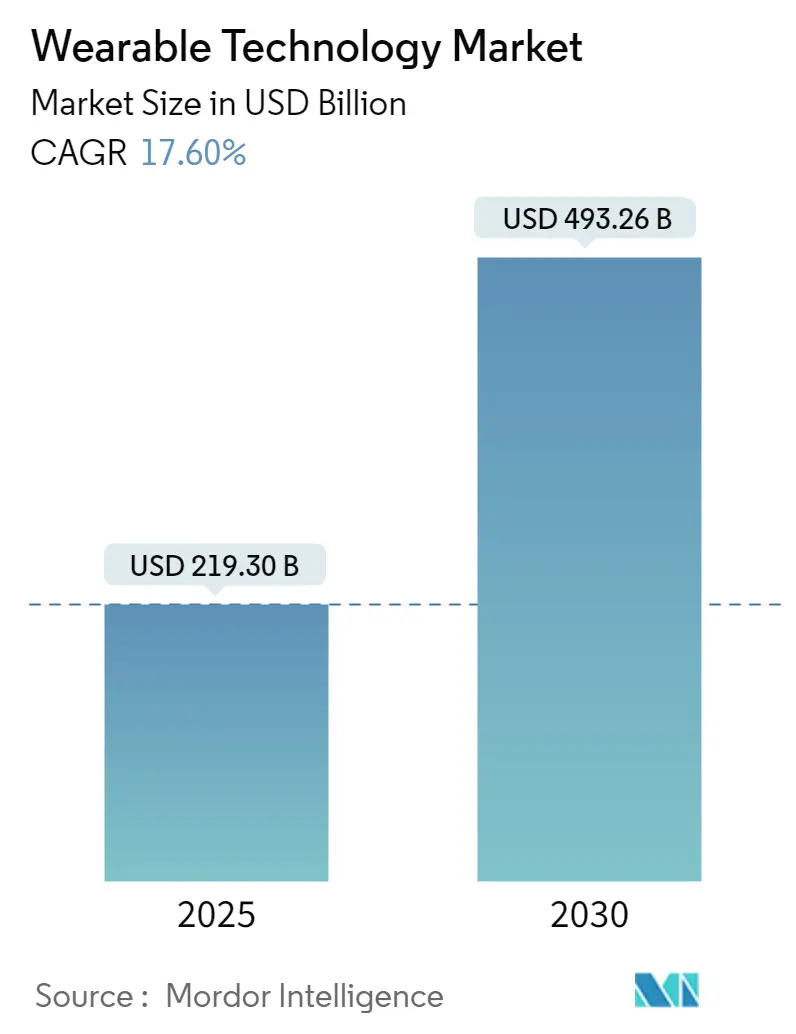
Mordor Intelligence has published a new report on the Wearable Technology Market, offering a comprehensive analysis of trends, growth drivers, and future projections.
The Wearable Technology Market is projected to be valued at USD 219.30 billion in 2025 and is anticipated to grow to USD 493.26 billion by 2030, registering a compound annual growth rate (CAGR) of 17.6% during the forecast period from 2025 to 2030. The advancement of wearable technology is primarily driven by the increasing adoption of MEMS sensors. These sensors are now widely integrated into wearable devices, largely due to the growing reliance on smartphones, which utilize GPS and Inertial Measurement Units (IMU) consisting of an accelerometer, gyroscope, and magnetometer.
Key Trends
- Integration of MEMS Sensors Enhancing Device Capabilities
The incorporation of MEMS sensors into wearable devices has significantly advanced their functionalities. These sensors, including accelerometers, gyroscopes, and magnetometers, enable precise tracking of user movements and environmental interactions. The widespread use of smartphones, which rely heavily on GPS and Inertial Measurement Units (IMUs), has further propelled the adoption of MEMS sensors in wearables, enhancing their performance in applications such as fitness tracking and navigation.
- Growing Demand for Health Monitoring Applications
Wearable devices are increasingly utilized for health monitoring, offering users real-time insights into various health metrics. Devices such as smartwatches and fitness trackers can monitor heart rate, sleep patterns, and physical activity levels, aiding in the management of personal health and wellness. The COVID-19 pandemic has further accelerated the adoption of health-focused wearables, as individuals seek tools to monitor their health remotely.
- Emergence of Smart Clothing
Smart clothing, also known as e-textiles or smart fabrics, is gaining traction within the wearable technology market. These garments incorporate advanced sensors and electronics to monitor various health indicators, such as heart rate, body temperature, and muscle activity. The integration of technology into textiles offers a seamless and comfortable user experience, expanding the applications of wearable technology in health and fitness.
Market Segmentation
The wearable technology market is segmented based on device type and geography:
- By Device Type:
- Smartwatches: Devices offering functionalities beyond timekeeping, including health monitoring, notifications, and app integrations.
- Head-Mounted Displays: Wearables positioned on the head, providing immersive experiences for applications such as virtual reality (VR) and augmented reality (AR).
- Wristbands: Bands worn on the wrist, primarily used for fitness and health tracking purposes.
- Ear-Wearables: Devices worn in the ear, including wireless earbuds with health monitoring features and voice assistants.
- Smart Clothing: Textiles integrated with sensors and electronics to monitor various health and fitness parameters.
- By Geography:
- North America: Currently holds the largest market share, driven by high consumer adoption and technological advancements.
- Asia-Pacific: Expected to witness the fastest growth, fueled by increasing disposable incomes and a growing tech-savvy population.
- Europe: Shows steady growth with rising health awareness and adoption of wearable devices.
- Latin America: Emerging market with potential growth opportunities due to increasing urbanization and health consciousness.
- Middle East & Africa: Gradual adoption of wearable technology, with growth prospects as technological infrastructure improves.
Get a Customized Report Tailored to Your Requirements: https://www.mordorintelligence.com/market-analysis/wearables
Key Players
The wearable technology market is characterized by significant competition, with key players focusing on innovation and expanding their product portfolios. Notable companies include:
- Apple Inc.: A leading player in the wearable technology market, known for its Apple Watch series, which integrates advanced health monitoring features and seamless connectivity with other Apple devices.
- Samsung Electronics Co., Ltd.: Offers a range of wearable devices, including smartwatches and fitness bands, with features such as health tracking, communication, and entertainment.
- Xiaomi Inc.: Provides affordable wearable devices with robust features, gaining significant market share, particularly in emerging markets.
- Fitbit Inc.: Specializes in fitness-focused wearables, offering devices that monitor various health metrics and provide personalized insights to users.
- Sony Corporation: Develops wearable devices with a focus on entertainment and fitness, incorporating advanced technologies to enhance user experience.
These companies are investing in research and development to introduce innovative features and improve the user experience, aiming to capture a larger share of the growing wearable technology market.
Conclusion
The wearable technology market is poised for substantial growth, driven by advancements in sensor integration, increasing health consciousness among consumers, and the emergence of innovative products such as smart clothing. As technology continues to evolve, wearable devices are becoming more sophisticated, offering a wide range of applications that enhance daily life. The focus on health monitoring and personalized user experiences will likely remain central to the strategies of key market players, ensuring the continued expansion and diversification of wearable technology offerings.
Industry Related Reports
Wearable Devices in Sports Market: The Wearable Technology in the Sports Market is categorized based on Device Type and Geography. By Device Type: Fitness & Heart Rate Monitors, Smart Clothing, GPS Trackers. By Geography: North America, Europe, Asia-Pacific, Latin America, Middle East & Africa.
Australia Wearables Market: The report focuses on Wearable Technology in Australia and is segmented based on End-User and Product. By End-User: Babies, Kids, Adults, Elderly By Product: Smartwatches, Head-Mounted Displays, Ear-Worn Devices, Fitness Trackers/Activity Trackers
Asia-Pacific Wearable Market: The Wearable Medical Device Industry in Asia-Pacific is categorized based on Product Type, Application, Device Type, and Geography. By Product Type: Wearable Vital Sign Monitor: Wearable Heart Rate Monitor, Wearable Activity Monitor, Wearable Electrocardiograph, Wearable Sleep Monitor, Wearable Fetal Monitor and Obstetric Device, Neuro-Monitoring Device, Respiratory Therapy Wearable Device, Glucose/Insulin Monitoring Wearable Device, Other Wearable Devices By Application: Sports and Fitness, Remote Patient Monitoring, Home Healthcare By Device Type: Watch, Wristband, Clothing, Ear Wear, Other Device Types By Geography: China, Japan, India, Australia, South Korea, Rest of Asia-Pacific
Industry-Related Reports:
Self Storage Software Market: The report focuses on the Global Self Storage Management Software Market, segmented by Enterprise Size (Small and Medium Enterprises, Large Enterprises), Type (PC-based and Cloud-based), and Geography.\
Self Service Bi Market: The Global Self-Service Business Intelligence Market is categorized by Type (Software and Services), Application (including Predictive Asset Maintenance, Fraud and Security Management, Sales and Marketing Management, Risk and Compliance Management, Supply Chain Management and Procurement, Operations Management, Customer Engagement, and Analysis), Deployment Model (On-Demand and On-Premises), End-User Industry (Healthcare, Manufacturing, BFSI, Retail and E-commerce, Telecommunications, Media and Entertainment, Transportation and Logistics, Energy and Utilities, Government and Defense), and Region.
Asia-Pacific Self Storage Market: The Asia Pacific Self Storage Market is divided by End-User (Personal and Business) and by Country (including Japan, China, Hong Kong and Taiwan, Singapore, Malaysia, and the Rest of Asia Pacific).
Mordor Intelligence is a trusted partner for businesses seeking comprehensive and actionable market intelligence. Our global reach, expert team, and tailored solutions empower organizations and individuals to make informed decisions, navigate complex markets, and achieve their strategic goals.
With a team of over 550 domain experts and on-ground specialists spanning 150+ countries, Mordor Intelligence possesses a unique understanding of the global business landscape. This expertise translates into comprehensive syndicated and custom research reports covering a wide spectrum of industries, including aerospace & defense, agriculture, animal nutrition and wellness, automation, automotive, chemicals & materials, consumer goods & services, electronics, energy & power, financial services, food & beverages, healthcare, hospitality & tourism, information & communications technology, investment opportunities, and logistics.
media@mordorintelligence.com
https://www.mordorintelligence.com/