
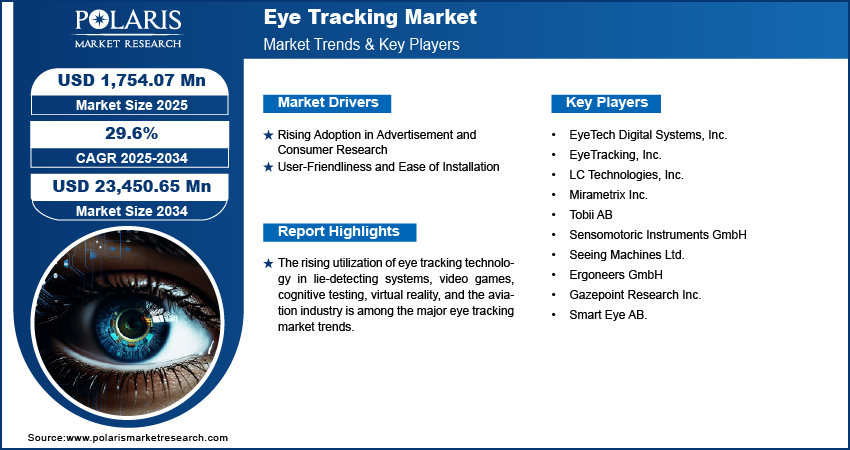
Global Eye Tracking Market size and share is currently valued at USD 1,316.47 million in 2024 and is anticipated to generate an estimated revenue of USD 23,450.65 million by 2034, according to the latest study by Polaris Market Research. Besides, the report notes that the market exhibits a robust 29.6% Compound Annual Growth Rate (CAGR) over the forecasted timeframe, 2025 – 2034
Market Overview:
The eye tracking market is witnessing significant growth as industries increasingly adopt eye-tracking technology for applications in healthcare, consumer electronics, automotive, gaming, marketing, and research. Eye tracking technology captures eye movement, gaze direction, and pupil dilation, providing insights into user behavior, cognitive processes, and interaction with digital environments.
The advancement of artificial intelligence (AI), machine learning (ML), and augmented reality (AR) has enhanced the capabilities of eye-tracking systems, making them more accurate and accessible. From assistive technologies for individuals with disabilities to eye-tracking-enabled smart devices, the market is rapidly evolving with new innovations.
Key Trends in the Eye Tracking Market:
Increasing Use of Eye Tracking in Virtual and Augmented Reality
Eye tracking is transforming VR/AR experiences by enabling foveated rendering, gaze-based navigation, and immersive gaming interactions. Companies are integrating this technology into VR headsets and AR glasses to enhance realism and efficiency.
Growth of Eye Tracking in Retail Analytics
Retailers are leveraging eye-tracking solutions to analyze customer attention, product engagement, and in-store navigation patterns. This data helps businesses improve store layouts, product placements, and personalized marketing strategies.
Advancements in Wearable and Mobile Eye Tracking Devices
Portable eye-tracking glasses, headsets, and contact lenses are gaining popularity, enabling real-time eye movement analysis in natural environments. These devices are widely used in sports training, behavioral research, and accessibility applications.
Expansion of Gaze-Based Human-Computer Interaction (HCI)
Eye tracking is revolutionizing human-computer interaction (HCI) by allowing users to control computers, mobile devices, and assistive technologies using eye movements. This innovation benefits individuals with disabilities, offering them hands-free control options.
Adoption of Eye Tracking in Gaming and eSports
Gaming companies are integrating eye-tracking technology into PCs, consoles, and eSports training tools to improve gameplay mechanics, reaction analysis, and user immersion. Eye-tracking enhances game realism and player engagement in competitive gaming.
Major Key Players:
- EyeTech Digital Systems, Inc.
- EyeTracking, Inc.
- LC Technologies, Inc.
- Mirametrix Inc.
- Tobii AB
- Sensomotoric Instruments GmbH
- Seeing Machines Ltd.
- Ergoneers GmbH
- Gazepoint Research Inc.
- Smart Eye AB.
𝐄𝐱𝐩𝐥𝐨𝐫𝐞 𝐓𝐡𝐞 𝐂𝐨𝐦𝐩𝐥𝐞𝐭𝐞 𝐂𝐨𝐦𝐩𝐫𝐞𝐡𝐞𝐧𝐬𝐢𝐯𝐞 𝐑𝐞𝐩𝐨𝐫𝐭 𝐇𝐞𝐫𝐞:
https://www.polarismarketresearch.com/industry-analysis/eye-tracking-market
Eye Tracking Industry Developments:
- June 2024: HONOR, a leading Chinese smartphone manufacturer, introduced AI Defocus Eye Protection and AI Deepfake Detection features for the smartphone market. These innovations leverage artificial intelligence (AI) to offer personalized user experiences while enhancing privacy protection.
- February 2024: Lumen Research secured a patent for its eye-tracking data collection platform. The company stated that the platform utilizes webcams on mobile and desktop devices to analyze user points of interest on web pages, enabling enhanced digital engagement insights.
𝐒𝐞𝐠𝐦𝐞𝐧𝐭𝐚𝐥 𝐀𝐧𝐚𝐥𝐲𝐬𝐢𝐬:
The research study includes segmental analysis that divides the market into distinct groups or segments based on common characteristics. With market segmentation, businesses can identify specific customer groups that are more likely to be interested in specific products or services. Also, it enables these businesses to focus their marketing efforts and resources more efficiently, leading to higher conversion rates and improved return on investment. Furthermore, segmentation analysis helps companies develop personalized products or services, which can result in increased customer loyalty and improved customer satisfaction.
By Type Outlook
- Remote Eye Tracking
- Mobile Eye Tracking
By Offering Outlook
- Hardware
- Software
- Services
By Application Outlook
- Assistive Communication
- Usability Testing
By End Users Outlook
- Consumer Electronics
- Automotive and Transportation
- Defense and Aerospace
- Retail
- Healthcare
- Others
The eye tracking market is rapidly expanding, driven by innovations in AI, AR/VR, consumer electronics, healthcare, and automotive safety. As eye-tracking technology becomes more accurate and accessible, its applications will continue to evolve across multiple industries.
With advancements in smart wearables, AI-powered analytics, and gaze-based interfaces, the future of eye tracking looks promising. Companies investing in eye-tracking research and development will play a crucial role in enhancing user experiences, improving accessibility, and driving technological innovation.
𝐁𝐫𝐨𝐰𝐬𝐞 𝐌𝐨𝐫𝐞 𝐑𝐞𝐬𝐞𝐚𝐫𝐜𝐡 𝐑𝐞𝐩𝐨𝐫𝐭𝐬:
Metal Air Battery Market Share
Industrial Control & Factory Automation Market Forecast