
Mordor Intelligence has published a new report on the Europe’s ADAS Market, offering a comprehensive analysis of trends, growth drivers, and future projections.
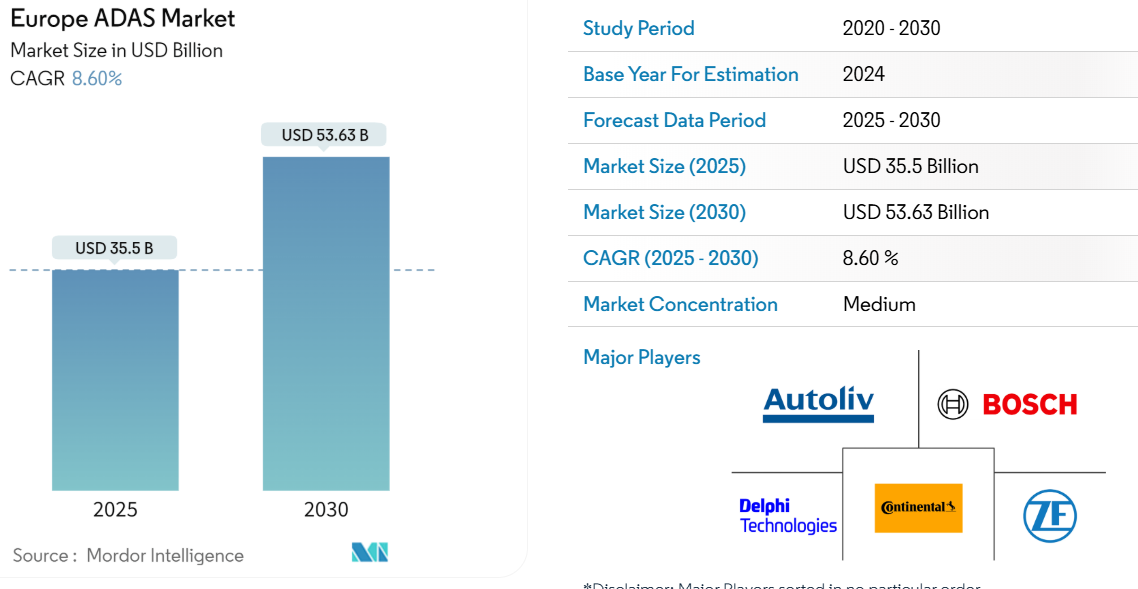
The Europe Advanced Driver Assistance Systems (ADAS) Market is projected to grow from USD 35.5 billion in 2025 to USD 53.63 billion by 2030, at a CAGR of 8.60%. The European automotive industry is undergoing a transformative phase, with Advanced Driver Assistance Systems (ADAS) playing a pivotal role in enhancing vehicle safety and driving experience. ADAS encompasses electronic systems that assist drivers in various functions, including navigation, collision avoidance, and parking, thereby reducing human error and improving road safety. The integration of these systems is rapidly becoming a standard in vehicles across Europe, driven by technological advancements and stringent regulatory frameworks.
Key Trends Driving the Market
-
Stringent Safety Regulations
-
European Union Initiatives: The European Union has implemented rigorous safety standards, mandating the inclusion of specific ADAS features in all new vehicles. This regulatory push aims to reduce road fatalities and aligns with the EU’s Vision Zero initiative, targeting zero road deaths by 2050.
-
Mandatory ADAS Features: Features such as Automatic Emergency Braking (AEB), Lane Departure Warning (LDW), and Intelligent Speed Assistance (ISA) have become compulsory in new vehicle models, propelling the adoption of ADAS technologies.
-
-
Technological Advancements in Sensor Technologies
-
Enhanced Sensor Integration: The evolution of sensor technologies, including radar, LiDAR, and cameras, has significantly improved the accuracy and reliability of ADAS. These advancements enable better object detection, real-time data processing, and seamless integration with vehicle control systems.
-
Artificial Intelligence (AI) and Machine Learning (ML): The incorporation of AI and ML algorithms facilitates predictive analytics and adaptive learning in ADAS, enhancing functionalities like driver monitoring and autonomous decision-making.
-
-
Consumer Demand for Enhanced Safety and Comfort
-
Growing Awareness: Increasing consumer awareness about vehicle safety and the benefits of ADAS features has led to higher demand for vehicles equipped with these systems. Consumers prioritize safety and convenience, influencing manufacturers to integrate ADAS across various vehicle segments.
-
Premium Features in Economy Vehicles: What was once exclusive to luxury vehicles is now permeating economy models, making advanced safety features accessible to a broader consumer base.
-
-
Development of Autonomous Vehicles
-
Progression Towards Autonomy: ADAS serves as the foundational technology for autonomous vehicles. Europe’s commitment to developing autonomous driving capabilities accelerates the integration of advanced driver assistance features, paving the way for higher levels of vehicle autonomy.
-
Pilot Programs and Testing: Numerous pilot programs and testing initiatives across Europe are focusing on autonomous driving, relying heavily on sophisticated ADAS technologies to ensure safety and functionality.
-
Market Segmentation
The Europe ADAS market is segmented based on type, technology, vehicle type, and geography.
-
By Type:
-
Parking Assist Systems: Assist drivers in parking maneuvers, utilizing sensors and cameras to detect obstacles and guide steering.
-
Adaptive Front-Lighting Systems: Adjust headlight angles and intensity based on driving conditions and vehicle speed to enhance nighttime visibility.
-
Night Vision Systems: Use infrared sensors to detect pedestrians, animals, or obstacles in low-light conditions, providing warnings to the driver.
-
Blind Spot Detection: Monitor areas alongside and behind the vehicle that are not visible to the driver, alerting them to potential hazards.
-
Lane Departure Warning Systems: Detect unintentional lane departures and provide alerts to the driver, promoting lane discipline.
-
-
By Technology:
-
Radar: Utilized for adaptive cruise control and collision avoidance by detecting the distance and speed of surrounding objects.
-
LiDAR: Offers precise 3D mapping of the environment, crucial for advanced functions like autonomous driving.
-
Camera: Employed for lane recognition, traffic sign recognition, and driver monitoring systems.
-
-
By Vehicle Type:
-
Passenger Cars: Encompasses sedans, hatchbacks, SUVs, and other personal vehicles increasingly equipped with ADAS features.
-
Commercial Vehicles: Includes trucks, buses, and vans where ADAS adoption is growing to enhance safety and efficiency in commercial transport.
-
-
By Geography:
-
Germany: A leader in automotive innovation, Germany exhibits high adoption rates of ADAS, driven by robust manufacturing and regulatory support.
-
United Kingdom: Significant growth in ADAS integration, supported by government initiatives and consumer demand for safety features.
-
France: Steady adoption of ADAS, with a focus on enhancing road safety and aligning with EU regulations.
-
Italy: Increasing incorporation of ADAS in vehicles, propelled by consumer awareness and regulatory mandates.
-
Rest of Europe: Encompasses other European countries adopting ADAS technologies at varying paces, influenced by local regulations and market dynamics.
-
Get a Customized Report Tailored to Your Requirements. – https://www.mordorintelligence.com/market-analysis/automotive-technology
Key Players in the Market
Several prominent companies are shaping the Europe ADAS market landscape:
-
Autoliv AB: Specializes in automotive safety systems, offering advanced ADAS solutions that enhance vehicle safety and performance.
-
Continental AG: Provides a comprehensive range of ADAS technologies, including radar and camera systems, contributing to safer driving experiences.
-
Delphi Automotive: Focuses on innovative ADAS solutions, integrating advanced sensors and software to support autonomous driving capabilities.
-
ZF Friedrichshafen AG: Offers a suite of ADAS products, emphasizing safety and automated driving functions.
-
Robert Bosch GmbH: A leading supplier of ADAS components, including sensors and control units, facilitating the development of intelligent driver assistance systems.
Conclusion
The Europe ADAS market is poised for substantial growth, driven by stringent safety regulations, technological advancements, and increasing consumer demand for enhanced vehicle safety and comfort. The projected growth from USD 35.5 billion in 2025 to USD 53.63 billion by 2030 underscores the critical role of ADAS in the future of the automotive industry. As technology continues to evolve, the integration of more sophisticated and reliable ADAS features will be essential in advancing towards fully autonomous vehicles and achieving the overarching goal of zero road fatalities in Europe.
Industry Related Reports