
Europe Pots & Pans for Residential End-Use Market Outlook
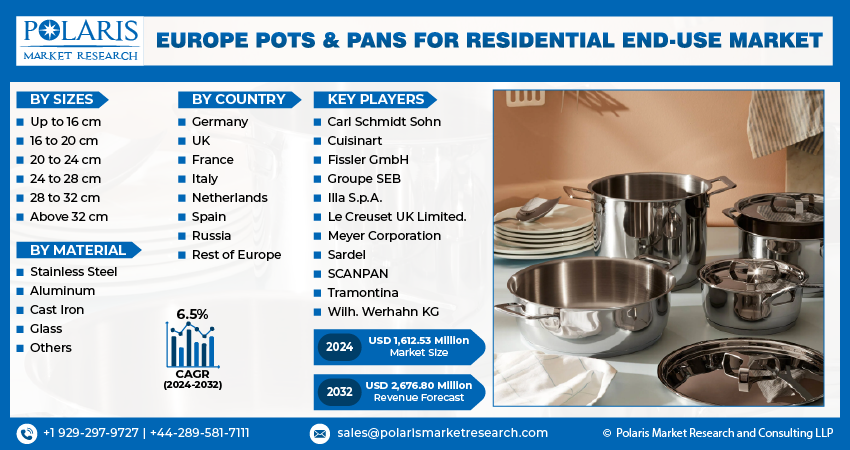
The Europe pots and pans market for residential end-use has been steadily growing over the past decade, driven by an increasing demand for high-quality cookware among consumers, combined with a rise in home cooking trends and the increasing popularity of culinary experiences at home. The demand for durable, versatile, and aesthetically pleasing pots and pans is a key driver for the market, which is also experiencing a shift towards premium products, innovative technologies, and eco-friendly materials.Europe pots & pans for residential end-use market size was valued at USD 1,519.31 million in 2023. The market is anticipated to grow from USD 1,612.53 million in 2024 to USD 2,676.80 million by 2032, exhibiting the CAGR of 6.5% during the forecast period.
This press release delves into the key trends shaping the market, key drivers of growth, challenges faced by manufacturers, regional market analysis, and a look at some of the leading companies operating in the European pots and pans market for residential use.
Market Overview and Summary
The European market for pots and pans designed for residential use has seen significant development in recent years. As people are increasingly spending more time cooking at home, whether as a hobby or out of necessity, the demand for high-quality kitchenware has escalated. With the growing focus on nutrition, health, and sustainability, consumers are looking for cookware that offers both performance and safety. The European cookware market is also being influenced by rising disposable income, technological innovations, and a preference for non-stick, stainless steel, and cast iron cookware.
The market is forecasted to experience a moderate yet steady growth rate in the coming years, bolstered by innovations in cookware design, materials, and technology. The growing trend of home cooking and food enthusiasts looking to replicate restaurant-quality dishes at home is expected to contribute to this upward trajectory.
Key Market Growth Drivers
- Growing Trend of Home Cooking and Culinary Enthusiasm The demand for pots and pans for residential end-use is largely driven by a surge in the number of people cooking at home. Factors such as more time spent at home, changes in eating habits, and a growing appreciation for homemade meals have contributed to this trend. Additionally, the rise of cooking television shows, YouTube channels, and social media influencers has played a significant role in encouraging consumers to experiment with cooking and invest in high-quality cookware.
- Technological Innovations in Cookware Materials The European cookware market has witnessed innovations in the design and materials of pots and pans. Modern cookware now features advanced technologies such as non-stick coatings, induction compatibility, and ergonomic handles, making cooking more convenient and enjoyable. These innovations in cookware are driving growth by enhancing product functionality and improving cooking performance, which appeals to a wider audience.
- Sustainability and Eco-Consciousness Sustainability is a growing concern for European consumers, with more individuals preferring eco-friendly and durable products. The market for pots and pans has seen an increase in the demand for cookware made from sustainable materials such as recycled aluminum, stainless steel, and cast iron. Additionally, manufacturers are investing in eco-conscious packaging and product lines, appealing to environmentally conscious consumers who are looking to reduce their carbon footprint.
- Rise in Disposable Income and Standard of Living Rising disposable incomes across Europe, particularly in developed countries, have also contributed to the growth of the residential cookware market. With more disposable income, consumers are opting for premium cookware sets, which are not only more durable but also offer superior cooking performance. Higher disposable income has also led to an increased focus on aesthetics, with cookware sets becoming a prominent part of kitchen décor.
Key Market Challenges
While the European pots and pans market for residential use is poised for growth, several challenges persist that could impede its expansion. These include:
- Rising Raw Material Costs The rising cost of raw materials such as stainless steel, aluminum, and copper is one of the key challenges facing the market. These materials are integral to the production of pots and pans, and price volatility can affect the cost structure of cookware manufacturers. This could, in turn, lead to higher prices for consumers, making premium cookware less accessible to certain segments of the market.
- Intense Competition The pots and pans market is highly competitive, with numerous established brands vying for market share. This intense competition leads to price wars, margin compression, and challenges for new entrants looking to carve out their niche in the market. Companies are increasingly relying on innovation, product differentiation, and brand reputation to stand out in this crowded space.
- Consumer Price Sensitivity While there is a growing demand for premium cookware, a significant portion of the European population remains highly price-sensitive. Many consumers prefer budget-friendly cookware options, which can make it difficult for premium brands to tap into certain segments of the market. Furthermore, economic uncertainty and fluctuations in consumer confidence can impact purchasing behavior and reduce overall demand.
- Product Substitution With the advent of modern cooking appliances such as air fryers, multi-cookers, and smart kitchen gadgets, there is a growing trend toward the substitution of traditional cookware. These new appliances offer convenience, versatility, and ease of use, which can reduce the demand for traditional pots and pans.
Browse Full Insights:https://www.polarismarketresearch.com/industry-analysis/europe-pots-and-pans-for-residential-end-use-market
Regional Analysis of the European Market
The European market for pots and pans is diverse, with significant demand across various regions, each having its own preferences and market dynamics.
- Western Europe Western European countries, particularly the UK, Germany, France, and Italy, are key players in the pots and pans market. These countries have strong culinary traditions, which have contributed to a high demand for premium cookware. Moreover, high disposable incomes and a growing focus on health and sustainability further drive the demand for high-quality kitchenware.
- Northern Europe Northern Europe, including countries like Sweden, Denmark, and Norway, also exhibits strong growth in the cookware market. The region has a high standard of living and a growing trend of home cooking, with many consumers focused on eco-friendly and sustainable products. The demand for quality cookware is rising as consumers look for long-lasting, performance-oriented cookware options.
- Eastern Europe While the pots and pans market in Eastern Europe is growing at a slower pace, it is gradually catching up to its Western counterparts. Countries such as Poland, Russia, and Hungary are witnessing an increase in disposable income, which is leading to higher demand for mid-to-premium range cookware. The region also sees a growing interest in home cooking, which is driving market growth.
Key Companies in the European Pots & Pans Market
Several leading players dominate the pots and pans market in Europe. These companies focus on innovation, sustainability, and product differentiation to capture consumer interest.
- Tefal (Groupe SEB) Tefal is one of the most prominent cookware brands in Europe, known for its high-quality non-stick cookware. The company is a leader in introducing innovative cookware solutions, such as induction-compatible and easy-to-clean products. Tefal has a strong presence across Europe and continues to invest in sustainability and product innovation.
- Le Creuset Known for its premium enameled cast iron cookware, Le Creuset is a prestigious brand in the European market. The company has built a strong reputation for creating aesthetically pleasing and long-lasting pots and pans. Its products are often seen as a blend of functionality and art, appealing to high-end consumers.
- WMF Group The German cookware manufacturer, WMF, is renowned for its high-end stainless-steel pots and pans. The company focuses on innovation and sustainability and offers a range of cookware for both professional and residential use. WMF continues to expand its market share by emphasizing quality, durability, and design.
- Fissler Fissler is another prominent player in the European market, particularly in the premium cookware segment. Known for its high-quality stainless-steel cookware, Fissler has a strong reputation for both performance and design. The company’s products cater to the needs of culinary enthusiasts and professional chefs alike.
- Cuisinart Cuisinart, a subsidiary of Conair, offers a wide range of cookware and kitchen appliances. Its products are popular for their combination of functionality, durability, and value for money, making it a popular choice for consumers looking for quality cookware at affordable prices.
Report Scope
Europe Pots & Pans For Residential End-Use Market, Sizes Outlook (Revenue – USD Million, 2019-2032)
- Up to 16 cm
- 16 to 20 cm
- 20 to 24 cm
- 24 to 28 cm
- 28 to 32 cm
- Above 32 cm
Europe Pots & Pans For Residential End-Use Market, Material Outlook (Revenue – USD Million, 2019-2032)
- Stainless Steel
- Aluminum
- Cast Iron
- Glass
- Others
Recent Developments
In September 2023, Outokumpu and Fissler partnered to introduce low-carbon stainless steel for sustainable cookware. This collaboration supports Fissler’s commitment to producing durable, long-lasting premium products. Fissler is focused on sustainability, using 100% recyclable stainless steel in their cookware and plans to incorporate Outokumpu Circle Green in an upcoming anniversary edition.
In August 2023, Cuisinart, the well-known cookware and home appliance brand, launched a limited-edition Caskata Collection in collaboration with the New England-based company. The six-piece collection features Caskata’s intricate blue and white patterns, combining style with practicality in the kitchen.
In June 2023, Tefal unveiled RENEW, an innovative cookware line made from 100% recycled aluminum and featuring Inoceramic non-stick coating. This collection is designed to promote healthier cooking with minimal use of added fats.
In July 2019, Sardel introduced its Italian-made 5-ply stainless steel cookware collection, known for its ergonomic handles, unique honeycomb non-stick surface, oven-safe features, and affordability.
Conclusion
The European pots and pans market for residential end-use is experiencing steady growth, driven by an increase in home cooking, consumer demand for premium cookware, and advancements in product innovation and sustainability. Despite challenges such as rising raw material costs and intense competition, the market remains robust, with significant potential for expansion, especially in eco-conscious and technology-driven segments.
Key players like Tefal, Le Creuset, WMF, Fissler, and Cuisinart continue to lead the market, responding to consumer preferences with innovative, durable, and aesthetically pleasing cookware. As the culinary landscape evolves, the European pots and pans market is poised to meet the growing needs of a diverse and discerning consumer base.
More Trending Latest Reports By Polaris Market Research:
Radio-Frequency Identification (RFID) Market