
Market Overview
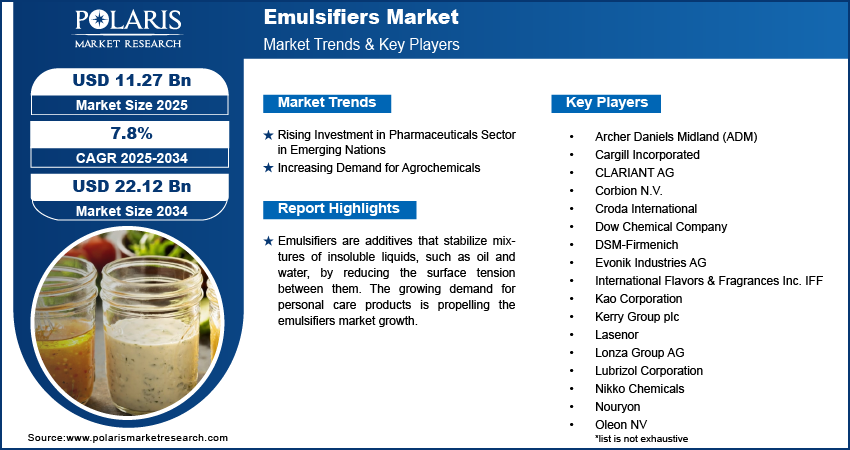
The global emulsifiers market is poised for robust growth over the next decade, driven by increasing consumer demand for clean-label and plant-based ingredients, technological advancements in food and personal care products, and expanding applications across various end-use industries. According to the latest market analysis, the market was valued at USD 10.48 billion in 2024 and is expected to grow from USD 11.27 billion in 2025 to USD 22.12 billion by 2034, registering a CAGR of 7.8% during the forecast period (2025–2034).
Emulsifiers, also known as emulsifying agents, are substances that help stabilize mixtures of oil and water by reducing surface tension. They are widely used in food, cosmetics, pharmaceuticals, and industrial formulations. The demand for natural emulsifiers—particularly those derived from plant and microbial sources—is witnessing a significant uptrend due to rising health awareness and regulatory support for safer, more sustainable additives.
The food industry remains the largest consumer of emulsifiers, using them to improve texture, extend shelf life, and enhance the sensory appeal of processed products. Food emulsifiers are particularly crucial in products such as margarine, ice cream, salad dressings, and baked goods.
Moreover, emulsifiers play an essential role in emulsifier applications beyond food—spanning personal care (e.g., lotions and creams), pharmaceuticals (e.g., drug delivery systems), and industrial processes (e.g., lubricants and paints). This wide-ranging utility reinforces their market relevance across diverse economic sectors.
Key Market Growth Drivers
-
Health-Conscious Consumer Behavior: The shift toward natural and organic food options has accelerated the use of plant-based emulsifiers such as lecithin, guar gum, and xanthan gum. Consumers are increasingly scrutinizing product labels, favoring ingredients that are both functional and naturally sourced.
-
Rising Demand in Personal Care and Cosmetics: The personal care industry’s growth, especially in emerging markets, is increasing the consumption of emulsifiers used in moisturizers, sunscreens, and anti-aging products. Consumers are looking for natural skin-care formulations, which necessitate innovative emulsifying systems.
-
Advancements in Emulsification Technology: New formulation techniques, including nanoemulsion and microemulsion systems, are enhancing emulsifier efficiency and stability. These innovations are encouraging manufacturers to adopt high-performance emulsifiers for improved product quality and consistency.
-
Processed Food Expansion in Emerging Economies: Urbanization, rising disposable incomes, and shifting dietary habits in developing countries are fueling the growth of processed and convenience foods, thereby driving demand for food emulsifiers.
-
Regulatory Push for Clean Label Products: Governmental and institutional initiatives promoting transparency in ingredient sourcing and labeling are creating a conducive regulatory environment for natural emulsifiers, thereby driving market expansion.
Emulsifiers Market Segment Insights
Emulsifiers Market Evaluation by Source Insights
Based on source, the emulsifiers market is divided into bio-based emulsifiers and synthetic emulsifiers. The synthetic emulsifiers segment dominated the market in 2024 due to its widespread use across industries such as food and beverages, pharmaceuticals, and personal care. Manufacturers prefer these additives for their cost-effectiveness, consistent performance, and ability to stabilize complex formulations. The food industry, in particular, relies heavily on synthetic options to enhance the texture and shelf life of processed products. Additionally, the personal care sector utilizes these compounds in skincare and cosmetic products to improve product consistency and application. Increased consumption of packaged foods, along with advancements in pharmaceutical formulations, further support the segment’s dominance in the market.
Emulsifiers Market Assessment by Application Insights
In terms of application, the emulsifiers market is segregated into food, cosmetics & personal care, oilfield chemicals, pharmaceuticals, agrochemicals, and others. The cosmetics & personal care segment is expected to grow at a rapid pace in the coming years owing to the rising demand for skincare, haircare, and beauty products. Consumers increasingly prefer high-performance formulations that offer smooth textures, prolonged stability, and enhanced sensory appeal. Natural and organic product trends have also driven the need for plant-based stabilizing agents as brands focus on cleaner ingredient labels and sustainability. Growing awareness of skin health, combined with the expansion of premium and functional beauty products, has encouraged manufacturers to develop innovative solutions that improve product application and effectiveness. Additionally, advancements in formulation technologies have enhanced the compatibility of stabilizers like emulsifiers with active ingredients, further strengthening their role in the cosmetics & personal care industry.
Browse Full Insights:
https://www.polarismarketresearch.com/industry-analysis/emulsifiers-market
Regional Analysis
North America:
North America remains a dominant player in the global emulsifiers market, driven by strong demand for processed and convenience foods, along with high awareness of clean-label trends. The United States leads the region due to robust investment in food technology and functional ingredient development.
Europe:
Europe is a significant market, underpinned by stringent food safety regulations and consumer preference for organic and non-GMO products. Germany, France, and the UK are key contributors, particularly in the food and personal care segments. The European Union’s focus on food transparency and sustainability is fostering demand for natural emulsifiers.
Asia Pacific:
Asia Pacific is the fastest-growing regional market, fueled by rapid urbanization, a growing middle-class population, and an expanding processed food sector. Countries like China, India, and Indonesia are witnessing increased consumption of emulsified products in both food and cosmetics. The region is also emerging as a manufacturing hub due to lower production costs and favorable government policies.
Latin America and Middle East & Africa (MEA):
These regions are also experiencing steady growth due to increasing adoption of westernized diets, expanding personal care markets, and industrial applications. Brazil, South Africa, and GCC countries are key emerging markets showing promising potential for emulsifier usage across various sectors.
Key Companies and Competitive Landscape
The emulsifiers market is moderately consolidated, with key players focusing on R&D, strategic partnerships, and portfolio expansion to maintain competitive advantage. Mergers and acquisitions are frequent, aiming to strengthen capabilities in emulsifying agents and clean-label formulations.
Prominent Market Players Include:
-
Cargill, Incorporated
-
Archer Daniels Midland Company (ADM)
-
BASF SE
-
DuPont de Nemours, Inc.
-
Kerry Group
-
Ingredion Incorporated
-
Lonza Group AG
-
Palsgaard A/S
-
Stepan Company
-
Royal DSM N.V.
These companies are investing heavily in plant-based and functional emulsifiers, driven by rising consumer demand for sustainable and health-focused products. For instance, Palsgaard A/S has developed emulsifiers based on renewable ingredients, while Cargill is expanding its range of lecithin products sourced from sunflower and soy.
Industry Challenges
Despite positive growth projections, the emulsifiers market faces several challenges:
-
Price Volatility of Raw Materials: Emulsifier production depends on feedstocks like soybeans, palm oil, and animal fats, which are subject to global supply fluctuations.
-
Regulatory Hurdles: Ensuring compliance with food safety and labeling regulations across different countries can be complex and costly.
-
Consumer Perception of Chemical Additives: Even though emulsifiers enhance food quality and safety, some synthetic variants are viewed skeptically by health-conscious consumers.
Future Outlook
The emulsifiers market is expected to undergo a paradigm shift toward sustainability, clean labeling, and plant-based innovation. Industry stakeholders are focusing on transparency, traceability, and functionality, while integrating new technologies to enhance performance and reduce environmental impact.
The incorporation of AI and data analytics into product development processes is further streamlining R&D efforts, allowing companies to tailor emulsifier functionality to meet evolving market demands.
More Trending Latest Reports By Polaris Market Research:
Chronic Obstructive Pulmonary Disease Market
Rare Disease Diagnostics Market
Biobased Polyvinyl Chloride Market
Pharmaceutical Aseptic Transfer Market
Fruit Beer Market: Breweries Providing Decoction to Artificially Flavor the Products