
Market Overview
The global cognitive computing market is experiencing rapid growth, fueled by transformative advancements in artificial intelligence (AI) and data analytics. Cognitive computing mimics human thought processes in a computerized model, using advanced technologies such as machine learning, natural language processing (NLP), neural networks, and speech recognition to analyze data, understand context, and provide insights that aid in decision-making.
Unlike traditional AI systems focused solely on automation or pattern recognition, cognitive computing systems are designed to simulate human reasoning and adaptability. These solutions can interpret unstructured data, learn from experience, and offer context-aware computing capabilities that are increasingly being integrated into healthcare, finance, retail, and manufacturing operations.
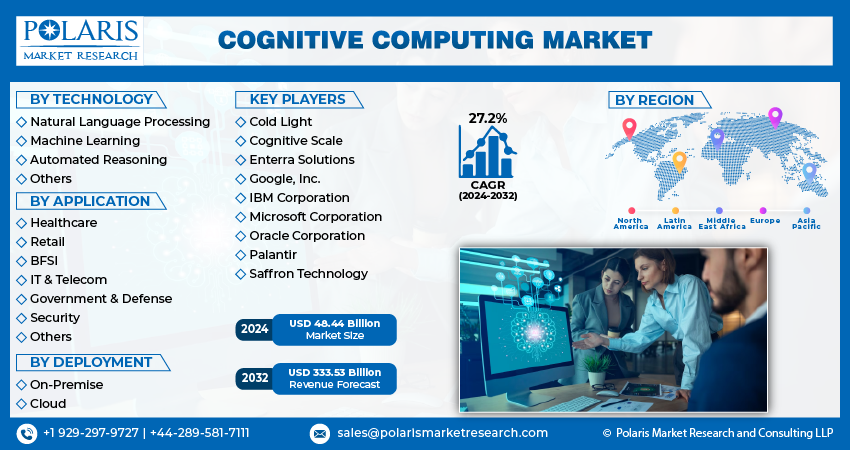
Global Cognitive Computing Market size and share is currently valued at USD 38.13 billion in 2023 and is anticipated to generate an estimated revenue of USD 333.53 billion by 2032, according to the latest study by Polaris Market Research. Besides, the report notes that the market exhibits a robust 27.2% Compound Annual Growth Rate (CAGR) over the forecasted timeframe, 2024 – 2032
Key Market Growth Drivers
-
Explosion of Big Data and Unstructured Information
Organizations today are overwhelmed with data — more than 80% of which is unstructured, coming from sources like emails, social media, videos, and customer service transcripts. Cognitive computing systems, driven by natural language processing and deep learning, offer businesses the ability to analyze this vast sea of information in real time and derive actionable insights.
-
Rising Adoption of AI in Enterprise Operations
Enterprises are increasingly embedding machine learning and cognitive systems into their workflows to drive efficiency, enhance customer experiences, and automate complex processes. Industries such as healthcare, where cognitive systems can support diagnostics and treatment recommendations, and finance, where they are used for fraud detection and portfolio management, are seeing particularly robust growth.
-
Demand for Personalized Customer Experiences
The shift toward customer-centric business models has accelerated the adoption of cognitive computing technologies. These systems can interpret user behaviors, sentiments, and preferences, allowing businesses to deliver tailored recommendations and seamless, context-aware computing experiences across digital platforms.
-
Advancements in Natural Language Processing
Recent breakthroughs in NLP have significantly improved the ability of machines to understand, interpret, and generate human language. These advances enable conversational interfaces, chatbots, and virtual assistants to become more human-like, accurate, and useful — greatly enhancing their value in customer service, healthcare, and education sectors.
-
Integration with Cloud Platforms and IoT Devices
Cognitive computing systems are increasingly being integrated with cloud services and IoT (Internet of Things) devices, enabling real-time data collection, analysis, and decision-making. This interconnected ecosystem fosters dynamic applications such as predictive maintenance, smart manufacturing, and autonomous vehicles.
Browse Full Insights:
https://www.polarismarketresearch.com/industry-analysis/cognitive-computing-market
Market Challenges
Despite its promising outlook, the cognitive computing market faces several obstacles that must be overcome to achieve widespread adoption:
-
High Implementation Costs and Complexity
The initial investment in cognitive computing infrastructure can be substantial. Building, training, and deploying cognitive models require specialized talent and significant computational resources, making it difficult for small and medium enterprises (SMEs) to adopt.
-
Data Privacy and Ethical Concerns
Cognitive systems often require access to sensitive data to function effectively. This raises concerns around data privacy, especially in highly regulated industries like healthcare and finance. Ethical considerations, including algorithmic bias and lack of transparency in decision-making, also present challenges for developers and regulators.
-
Shortage of Skilled Professionals
There is a significant talent gap in the fields of AI, data science, and cognitive system engineering. Organizations struggle to find professionals who possess the required expertise in machine learning, NLP, and algorithm development.
-
Integration with Legacy Systems
Many organizations still rely on legacy IT infrastructures that are incompatible with modern cognitive computing platforms. Seamless integration of new systems with existing workflows remains a technical and operational challenge.
Regional Analysis
North America holds the dominant share in the cognitive computing market, largely due to the presence of leading technology companies, high R&D investments, and early adoption across multiple industries. The United States is at the forefront, with widespread deployment of AI in healthcare, finance, government, and retail sectors. Initiatives like AI research grants and federal funding further support innovation and commercialization.
Europe is the second-largest market, with strong growth in countries like Germany, the UK, and France. European organizations are integrating AI-powered decision-making into enterprise resource planning, customer relationship management, and supply chain analytics. The European Union’s push for ethical AI practices and GDPR-compliant data strategies is also shaping market dynamics.
Asia-Pacific is the fastest-growing region, fueled by massive investments in AI and digital transformation by China, Japan, South Korea, and India. China, in particular, has identified AI and cognitive technologies as strategic priorities, investing billions into research hubs and startup ecosystems. The region’s thriving IT services sector and rising demand for automation in manufacturing are also accelerating adoption.
Latin America, the Middle East, and Africa are emerging markets for cognitive computing. While still in the early stages of adoption, growing digitalization, expanding internet penetration, and government initiatives to modernize public infrastructure are expected to drive future growth.
Key Companies in the Cognitive Computing Market
Several technology giants and innovative startups are actively shaping the landscape of the cognitive computing market. Key players include:
-
IBM Corporation: A pioneer in cognitive computing, IBM’s Watson platform offers AI solutions across healthcare, legal, finance, and education sectors. Watson’s ability to process natural language and analyze unstructured data has positioned it as a flagship solution in the market.
-
Microsoft Corporation: Through its Azure Cognitive Services, Microsoft provides cloud-based tools for vision, speech, language, and decision-making. These services are widely used in enterprise AI solutions and chatbot development.
-
Google LLC (Alphabet Inc.): Google’s AI division leverages cognitive computing in its search algorithms, Google Assistant, and cloud AI platforms. The company’s investments in NLP and machine learning have made it a major player in the space.
-
Amazon Web Services (AWS): AWS offers AI and machine learning services that power cognitive applications in e-commerce, recommendation engines, and voice-enabled devices like Alexa.
-
Nuance Communications (a Microsoft company): Specializing in healthcare-focused cognitive systems, Nuance develops AI-driven speech recognition and documentation tools for medical professionals.
-
SparkCognition: An emerging leader in industrial AI, SparkCognition provides context-aware computing solutions for energy, defense, and manufacturing sectors using cognitive analytics and machine learning.
-
CognitiveScale: Focused on AI engineering for the enterprise, CognitiveScale develops platforms that improve customer engagement, risk management, and decision intelligence.
These companies are investing in R&D, strategic partnerships, and acquisitions to expand their market share and develop innovative products.
Market Segmentation:
Cognitive Computing Market, Deployment Outlook (Revenue – USD Billion, 2019-2032)
- On-Premise
- Cloud
Cognitive Computing Market, Application Outlook (Revenue – USD Billion, 2019-2032)
- Healthcare
- Retail
- BFSI
- IT & Telecom
- Government & Defense
- Security
- Others
Cognitive Computing Market, Technology Outlook (Revenue – USD Billion, 2019-2032)
- Natural Language Processing
- Machine Learning
- Automated Reasoning
- Others
Future Outlook
The future of the cognitive computing market is incredibly promising, with continuous innovation driving new applications across verticals. Emerging trends such as generative AI, edge computing, and quantum machine learning are expected to enhance the capabilities of cognitive systems further.
As enterprises strive for smarter operations and enhanced user engagement, cognitive computing will play a pivotal role in bridging the gap between data and decisions. The integration of natural language processing, machine learning, and AI-powered decision-making into business ecosystems will drive productivity, improve agility, and unlock unprecedented opportunities for growth.
To fully realize this potential, stakeholders must address challenges related to scalability, ethics, and data governance. Nevertheless, with strong momentum and evolving technological foundations, the global cognitive computing market is poised to become a cornerstone of digital transformation in the coming decade.
More Trending Latest Reports By Polaris Market Research: