
Market Overview
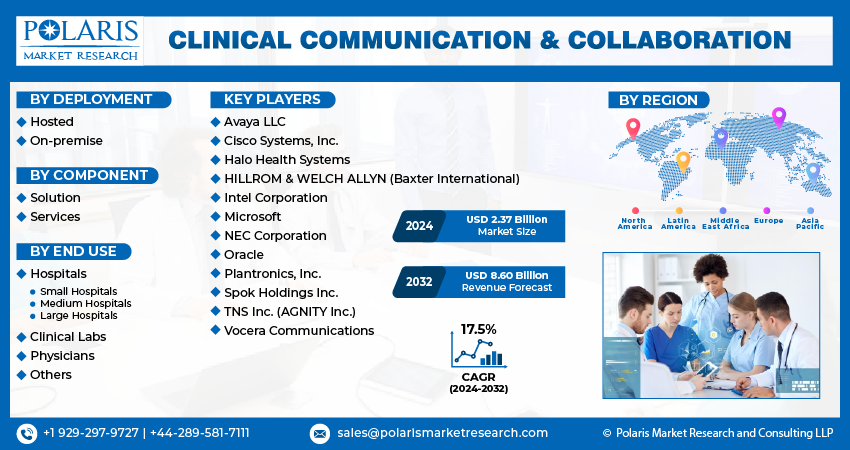
Global Clinical Communication and Collaboration Market size and share is currently valued at USD 2.05 billion in 2023 and is anticipated to generate an estimated revenue of USD 8.60 billion by 2032, according to the latest study by Polaris Market Research. Besides, the report notes that the market exhibits a robust 17.5%Compound Annual Growth Rate (CAGR) over the forecasted timeframe, 2024 – 2032
The Clinical Communication and Collaboration market is rapidly emerging as a critical component of digital healthcare infrastructure. It encompasses software platforms and communication tools designed to streamline workflows, enhance collaboration among clinical teams, and improve patient outcomes. These systems integrate various forms of communication—such as voice, text, alerts, and video—across devices and departments in a secure and compliant manner.
Key Market Growth Drivers
- Rising Demand for Patient Care Coordination and Team-Based Care
One of the primary drivers of the CC&C market is the growing emphasis on patient care coordination. As healthcare delivery shifts from siloed, specialist-based care to integrated and team-based models, the need for platforms that unify communication across multidisciplinary teams becomes imperative.
Clinical Communication and Collaboration tools ensure that physicians, nurses, pharmacists, and administrative staff have real-time access to patient updates, reducing errors and enhancing continuity of care—particularly in acute and post-acute care settings.
- Adoption of Clinical Mobility Solutions
The rise of clinical mobility is transforming the way healthcare professionals access and share information. Mobile-enabled communication tools are enabling clinicians to collaborate at the point of care using smartphones, tablets, and other mobile devices. This trend is supported by bring-your-own-device (BYOD) policies and the availability of mobile-optimized healthcare communication platforms.
Clinical mobility ensures that critical alerts, lab results, and patient updates reach the right team members without delay, significantly improving response times and operational efficiency.
- Emphasis on Secure Messaging and Compliance
The healthcare industry is under increasing pressure to maintain compliance with data protection regulations such as HIPAA (U.S.), GDPR (Europe), and others. Traditional communication methods like pagers, unsecured emails, and text messages are no longer viable in high-risk environments.
Secure messaging platforms have emerged as a vital solution, allowing encrypted communication between care teams while ensuring full audit trails and integration with electronic health records (EHRs). These tools not only safeguard patient data but also enable seamless handoffs, task assignments, and clinical escalation workflows.
- Surge in Telehealth and Remote Patient Monitoring
The post-pandemic healthcare landscape has witnessed a sustained rise in telehealth and remote patient monitoring. As virtual care becomes more mainstream, CC&C platforms are evolving to support integrated communication between on-site and remote clinical staff. This includes secure video consultations, shared care plans, and alerts triggered by remote devices, all managed through unified communication dashboards.
This convergence of telehealth and CC&C supports more holistic and proactive patient care delivery.
Browse Full Insights:
https://www.polarismarketresearch.com/industry-analysis/clinical-communication-collaboration-market
Market Challenges
Despite the robust growth outlook, the Clinical Communication and Collaboration market faces several operational and strategic hurdles:
- Interoperability with Legacy Systems
Healthcare environments often rely on a mix of legacy systems, including outdated paging systems, stand-alone communication tools, and siloed EHRs. Ensuring interoperability between CC&C platforms and these existing systems can be complex and resource-intensive.
Vendors must offer flexible integration capabilities with clinical systems, PACS, and health information exchanges (HIEs) to gain adoption across diverse provider networks.
- Budget Constraints and ROI Concerns
While the long-term benefits of CC&C platforms are evident, many healthcare providers—especially in developing economies and smaller practices—struggle with the upfront costs. These include software licenses, mobile devices, staff training, and ongoing IT support.
Demonstrating a clear return on investment (ROI), such as reduced readmissions, faster discharge times, and improved clinician satisfaction, remains crucial for widespread market penetration.
- Resistance to Workflow Changes
Healthcare professionals often operate in high-pressure, time-sensitive environments. The introduction of new communication platforms may face resistance if perceived as disruptive or cumbersome.
Effective user training, seamless UX design, and clinical workflow alignment are essential to achieving high adoption rates.
- Cybersecurity Threats
Although secure messaging solutions are designed to mitigate data breaches, the risk of cyberattacks remains a concern, especially with increased use of mobile and cloud-based systems. Ensuring end-to-end encryption, role-based access controls, and robust cybersecurity policies is vital to maintaining trust.
Regional Analysis
North America
North America leads the global CC&C market, accounting for over 40% of total revenue in 2024. The U.S. is the dominant player due to its mature healthcare IT infrastructure, regulatory mandates (e.g., HIPAA), and growing investments in digital transformation. Clinical mobility and secure messaging are widespread in U.S. hospitals, particularly among large healthcare systems and accountable care organizations (ACOs).
Europe
Europe represents the second-largest regional market, driven by increasing pressure on healthcare systems to reduce medical errors, shorten hospital stays, and improve workforce efficiency. The U.K., Germany, and the Netherlands are leading adopters of healthcare communication platforms, supported by national e-health initiatives and data security regulations under GDPR.
Asia-Pacific
Asia-Pacific is projected to experience the fastest growth during the forecast period. Countries like China, India, Japan, and Australia are investing heavily in healthcare IT, mobile health, and hospital modernization. Rising population, urbanization, and a growing burden of chronic diseases are pushing providers to adopt communication tools that enhance patient engagement and coordination.
Latin America and Middle East & Africa
Though smaller in market share, these regions are seeing growing interest in CC&C platforms, especially in urban healthcare hubs. Brazil, Saudi Arabia, and South Africa are investing in hospital automation and mobile workforce tools. However, adoption is still hindered by infrastructure limitations and lower digital literacy.
Key Companies in the Clinical Communication and Collaboration Market
Several leading companies are shaping the trajectory of the CC&C industry through technological innovation, cloud integration, and strategic partnerships. These firms focus on delivering scalable solutions that meet the needs of hospitals, outpatient clinics, and home care providers.
- Avaya LLC
- Cisco Systems, Inc.
- Halo Health Systems
- HILLROM & WELCH ALLYN (Baxter International)
- Intel Corporation
- Microsoft
- NEC Corporation
- Oracle
- Plantronics, Inc.
- Spok Holdings Inc.
- TNS Inc. (AGNITY Inc.)
- Vocera Communications
These key players are continuously investing in AI-driven workflows, voice recognition, and analytics to help healthcare organizations improve responsiveness, streamline operations, and enhance patient outcomes.
Conclusion
The Clinical Communication and Collaboration market is rapidly evolving to meet the needs of a modern, mobile, and interconnected healthcare ecosystem. With its role in improving patient care coordination, reducing clinical errors, and accelerating time-sensitive communication, CC&C platforms are becoming indispensable in hospitals, long-term care facilities, and outpatient centers worldwide.
More Trending Latest Reports By Polaris Market Research:
In-flight Entertainment and Connectivity (IFEC) Market
Electronic Contract Manufacturing Services Market