
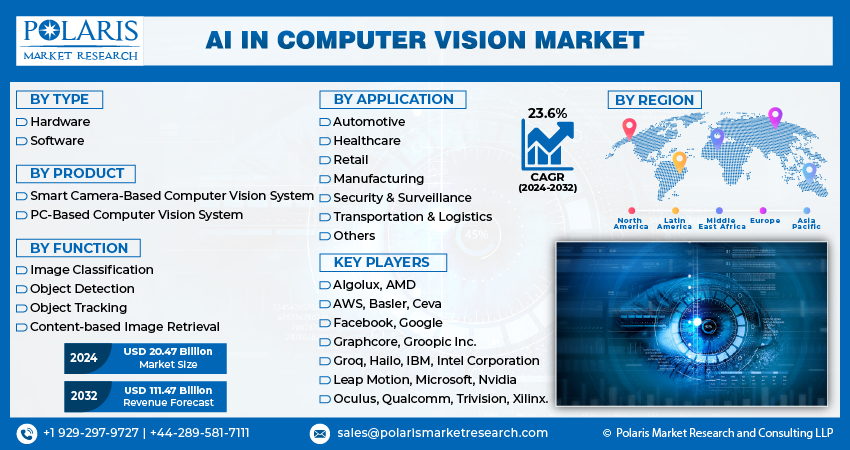
The global market for Artificial Intelligence (AI) in computer vision is poised for exponential growth. Valued at USD 16.57 billion in 2023, the sector is expected to grow rapidly, with projections indicating a rise to USD 20.47 billion in 2024, and a staggering USD 111.47 billion by 2032. This remarkable growth trajectory represents a compound annual growth rate (CAGR) of 23.6% during the forecast period from 2024 to 2032.
In recent years, AI has become an integral part of technological advancements, enabling machines to process and analyze visual data in ways that were previously unimaginable. The combination of AI and computer vision is revolutionizing a range of industries, from healthcare to retail, automotive, and beyond. As AI continues to evolve, its ability to enhance computer vision systems will play a crucial role in shaping the future of automation, data analysis, and machine learning.
Key Factors Driving Market Growth
- Advancements in AI and Machine Learning: AI-powered computer vision systems are becoming increasingly sophisticated, allowing machines to interpret and analyze visual data with incredible accuracy. Machine learning algorithms, particularly deep learning, have played a pivotal role in improving the performance of computer vision technologies. These advancements have made AI in computer vision more practical and accessible, enabling businesses to integrate it into their operations and products.
- Increased Demand for Automation: One of the most significant drivers of the AI in computer vision market is the growing demand for automation across various sectors. AI-powered computer vision systems enable machines to perform complex tasks that would traditionally require human intervention. This includes image recognition, object detection, facial recognition, and more. As industries look to reduce labor costs and improve efficiency, the demand for automated solutions is expected to rise.
- Rise in Data Generation and Availability: The increasing availability of large volumes of data, including images and videos, is another key factor contributing to the growth of the AI in computer vision market. The ability to process and analyze this data is critical for businesses that want to extract meaningful insights. Computer vision systems powered by AI are uniquely suited to process visual data, making them indispensable for sectors such as healthcare, retail, and manufacturing.
- Technological Integration with IoT: The integration of AI and computer vision with the Internet of Things (IoT) is creating new opportunities for growth. IoT devices, such as sensors, cameras, and smart devices, are generating vast amounts of data that can be analyzed using AI-powered computer vision systems. This synergy between AI, computer vision, and IoT is enabling real-time decision-making and improving operational efficiency across industries.
- Government and Private Sector Investments: Both government bodies and private organizations are investing heavily in AI and computer vision research. These investments are not only fueling technological innovation but also creating new opportunities for market growth. Governments around the world are supporting the development of AI technologies through funding, policy initiatives, and infrastructure development, further accelerating market expansion.
𝐄𝐱𝐩𝐥𝐨𝐫𝐞 𝐓𝐡𝐞 𝐂𝐨𝐦𝐩𝐥𝐞𝐭𝐞 𝐂𝐨𝐦𝐩𝐫𝐞𝐡𝐞𝐧𝐬𝐢𝐯𝐞 𝐑𝐞𝐩𝐨𝐫𝐭 𝐇𝐞𝐫𝐞:
Industry Applications Driving Market Adoption
- Healthcare and Medical Imaging: AI in computer vision is making significant strides in the healthcare industry, particularly in medical imaging. Computer vision technologies are being used to analyze X-rays, MRIs, and other medical images to detect abnormalities, identify diseases, and assist in diagnosis. The accuracy and speed with which AI-powered systems can analyze medical images are helping doctors make more informed decisions, improving patient outcomes, and streamlining healthcare processes.
- Retail and E-Commerce: In the retail and e-commerce sectors, AI-driven computer vision is enhancing the shopping experience. AI is being used for customer behavior analysis, inventory management, and even in cashier-less stores where computer vision systems track items picked up by customers. Facial recognition technology is also being deployed for personalized advertising and targeted marketing campaigns, providing retailers with a valuable tool for boosting sales.
- Automotive and Autonomous Vehicles: The automotive industry is another major adopter of AI in computer vision. Computer vision plays a crucial role in the development of autonomous vehicles, where it helps vehicles interpret their surroundings and make decisions based on visual data. AI-powered systems are used for object detection, lane detection, traffic sign recognition, and more, enabling safer and more efficient self-driving cars.
- Manufacturing and Quality Control: AI in computer vision is being used extensively in manufacturing for quality control and defect detection. Vision systems can quickly and accurately identify defects in products during the production process, reducing the need for manual inspection and minimizing errors. This has led to improved product quality, reduced waste, and greater operational efficiency in manufacturing plants.
- Security and Surveillance: Security and surveillance are also benefiting from AI-powered computer vision systems. These systems are being used for facial recognition, object tracking, and anomaly detection in real-time. In public spaces, AI-based computer vision systems can analyze live video feeds to detect suspicious activities, identify potential threats, and alert security personnel. This technology is proving invaluable in enhancing public safety and security operations.
Key Players in the AI in Computer Vision Market
The AI in computer vision market is highly competitive, with numerous players vying for market share. Key players in the market include:
- NVIDIA Corporation: As a leader in AI and GPU technologies, NVIDIA is a major player in the AI-powered computer vision market. The company’s hardware and software solutions are widely used in industries such as healthcare, automotive, and retail, driving the adoption of AI in computer vision systems.
- Intel Corporation: Intel is another key player in the market, offering AI chips and solutions that support computer vision applications. The company’s AI hardware and software products are being utilized across a range of industries, from robotics to security and surveillance.
- Microsoft Corporation: Microsoft has made significant investments in AI, and its Azure AI platform is being used to develop and deploy computer vision solutions. The company’s cloud-based services and AI tools are helping businesses integrate AI into their operations with ease.
- Qualcomm Technologies, Inc.: Qualcomm is known for its AI-powered chips that support computer vision applications in devices such as smartphones, drones, and cameras. The company’s AI solutions are helping manufacturers build smarter devices that can interpret visual data in real-time.
- Amazon Web Services (AWS): AWS is leveraging its cloud computing infrastructure to provide AI and machine learning services that power computer vision applications. Through services such as AWS Rekognition, Amazon is making it easier for businesses to integrate computer vision capabilities into their operations.
Challenges and Opportunities in the Market
While the growth potential of AI in computer vision is substantial, the market does face several challenges.
- Data Privacy and Security Concerns: The use of AI-powered computer vision in areas like facial recognition and surveillance has raised concerns about data privacy and security. Governments and regulatory bodies are beginning to implement policies and regulations to address these issues, which could impact the adoption of these technologies.
- High Costs of Implementation: The development and implementation of AI in computer vision systems can be expensive, particularly for small and medium-sized enterprises. However, as technology advances and costs decrease, more businesses are expected to adopt these solutions.
- Lack of Skilled Workforce: The rapid growth of AI and computer vision technologies has created a demand for skilled professionals who can develop, implement, and manage these systems. Companies in the AI space are facing challenges in finding and retaining talent with expertise in AI and machine learning.
- Opportunities in Emerging Markets: While North America and Europe are leading the charge in AI adoption, emerging markets in Asia-Pacific, Latin America, and the Middle East present significant growth opportunities. As industries in these regions recognize the potential of AI-powered computer vision, demand for these technologies is expected to rise.
Conclusion
The global AI in computer vision market is undergoing a transformative period, with rapid advancements in technology, increased demand for automation, and significant investments driving its growth. As industries across the globe continue to harness the power of AI and computer vision, the market is expected to grow at an extraordinary pace, reaching USD 111.47 billion by 2032.
The key applications of AI in computer vision, such as in healthcare, retail, automotive, and manufacturing, are reshaping industries and creating new opportunities for innovation and efficiency. However, the market must overcome challenges such as data privacy concerns, high implementation costs, and a shortage of skilled workers.
Overall, the future of AI in computer vision looks promising, with significant opportunities for companies and industries to leverage this transformative technology for competitive advantage.
𝐁𝐫𝐨𝐰𝐬𝐞 𝐌𝐨𝐫𝐞 𝐑𝐞𝐬𝐞𝐚𝐫𝐜𝐡 𝐑𝐞𝐩𝐨𝐫𝐭𝐬:
Point-Of-Sale (Pos) Terminals Market
Identity & Access Management (Iam) Market
Voice And Speech Recognition Market
Meditation Management Apps Market