
Market Overview
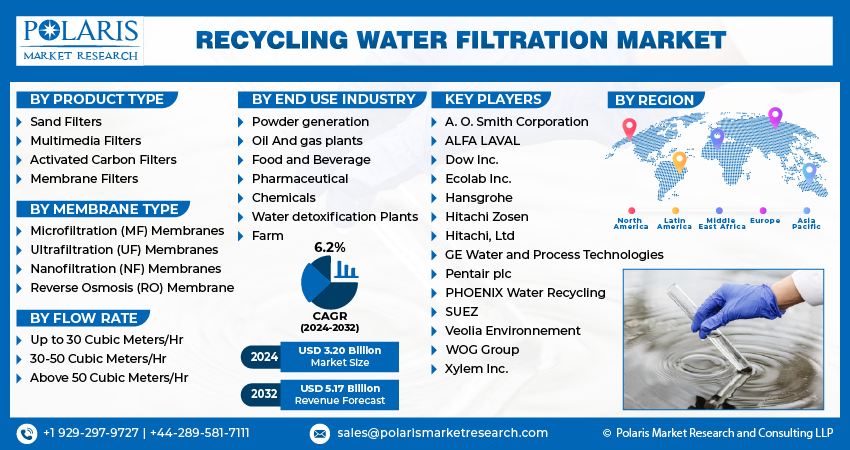
The global recycling water filtration market is undergoing rapid growth, fueled by the rising demand for sustainable water management solutions. Global recycling water filtration market size was valued at USD 3.02 billion in 2023. The market is anticipated to grow from USD 3.20 billion in 2024 to USD 5.17 billion by 2032, exhibiting the CAGR of 6.2% during the forecast period
Water scarcity, environmental regulations, and growing urban populations are driving both industrial and municipal sectors to adopt advanced recycling and filtration technologies. These systems enable the reuse of wastewater through filtration techniques that remove physical, chemical, and biological contaminants—promoting sustainable water use across agriculture, manufacturing, and residential sectors.
Market Growth Drivers
1. Rising Water Scarcity and Climate Change
Global freshwater resources are under increasing stress due to population growth, urbanization, and climate change. Recycling water through effective filtration technologies has become a crucial strategy to conserve water and maintain sustainable ecosystems. Governments and organizations are investing in infrastructure that supports water reuse to reduce dependency on natural water bodies.
2. Stringent Environmental Regulations
Governments around the world have implemented strict regulations concerning wastewater discharge. Regulatory frameworks such as the U.S. Clean Water Act and the EU Urban Waste Water Treatment Directive encourage industries to install water recycling systems to minimize environmental impact.
3. Increased Industrial and Agricultural Demand
Industries such as textiles, chemicals, food & beverage, and mining consume large volumes of water. Recycling helps reduce operational costs while ensuring compliance with regulations. Similarly, agriculture, the largest water-consuming sector globally, is adopting recycled water for irrigation to cope with dwindling freshwater supplies.
4. Technological Advancements in Filtration Systems
Emerging technologies such as reverse osmosis, UV filtration, membrane bioreactors, and advanced oxidation processes are significantly improving the efficiency and affordability of recycling water filtration systems. These innovations are making it easier for both developed and developing regions to adopt these solutions.
5. Urbanization and Smart City Initiatives
As cities grow and infrastructure becomes more complex, municipal authorities are increasingly integrating water recycling systems into smart city planning. Urban centers are adopting greywater recycling and decentralized wastewater treatment solutions to promote self-sustaining water ecosystems.
Browse Full Insights:
https://www.polarismarketresearch.com/industry-analysis/recycling-water-filtration-market
Key Market Trends
● Integration of IoT and AI in Filtration Systems
Smart monitoring systems powered by IoT and AI are being integrated into filtration units, enabling real-time data collection, predictive maintenance, and efficient energy use. These technologies improve system performance while reducing operational costs.
● Shift Toward Decentralized Water Treatment
Decentralized water recycling systems are gaining traction in residential and commercial buildings. These compact units allow on-site water reuse, reducing the burden on centralized treatment facilities and providing resilience during water supply disruptions.
● Rise in Green Building Certifications
Green building standards such as LEED and BREEAM encourage water recycling installations. The construction of eco-friendly commercial and residential buildings is boosting the demand for embedded water filtration and recycling technologies.
● Growing Public Awareness and Education
Consumer awareness around water conservation and environmental protection is encouraging the adoption of home water recycling systems. Public campaigns and educational initiatives are driving demand for user-friendly domestic filtration solutions.
Research Scope
The research scope of the recycling water filtration market includes a detailed analysis of current market dynamics, competitive landscape, technology trends, and regulatory impacts across different regions. Key areas covered in the market research include:
-
Historical data and forecast analysis from 2020 to 2032
-
Market value and volume trends
-
Competitive benchmarking and company profiles
-
Market share analysis by technology, end-use, and geography
-
SWOT and Porter’s Five Forces analysis
-
Regulatory frameworks and their market implications
-
Emerging opportunities and potential investment hotspots
This comprehensive approach enables stakeholders to make informed decisions regarding product innovation, market entry, and strategic partnerships.
Market Segmentation
The recycling water filtration market can be segmented by technology, end-use, and region:
● By Technology:
-
Reverse Osmosis (RO)
-
Ultrafiltration (UF)
-
Membrane Bioreactor (MBR)
-
Activated Carbon Filtration
-
UV Disinfection
-
Others
● By End-Use:
-
Industrial
-
Manufacturing
-
Chemical Processing
-
Power Generation
-
-
Residential
-
Greywater Recycling
-
Rainwater Harvesting
-
-
Commercial
-
Hospitality
-
Offices
-
-
Municipal
-
Wastewater Treatment Plants
-
Urban Reuse Projects
-
-
Agricultural
-
Irrigation with Recycled Water
-
● By Region:
-
North America
-
U.S.
-
Canada
-
-
Europe
-
Germany
-
U.K.
-
France
-
-
Asia-Pacific
-
China
-
India
-
Japan
-
-
Latin America
-
Brazil
-
Mexico
-
-
Middle East & Africa
-
UAE
-
South Africa
-
Asia-Pacific is expected to witness the fastest growth due to increasing industrialization, government initiatives for wastewater treatment, and rising water stress in countries like India and China.
Conclusion
The global recycling water filtration market is set to expand significantly over the coming years, driven by the need for sustainable water use, stricter environmental policies, and growing awareness of water scarcity issues. With advanced filtration technologies becoming more accessible, and smart infrastructure trends gaining momentum, the market presents promising opportunities for businesses, investors, and policymakers focused on building a water-secure future.