
Market Overview:
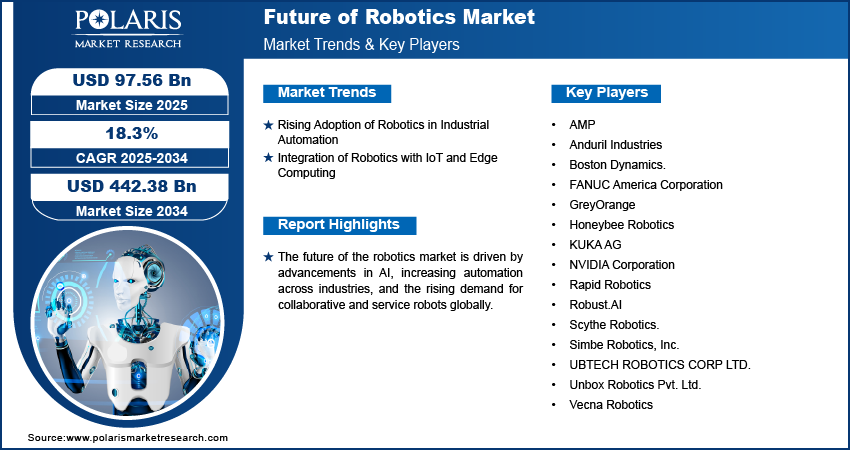
The future of robotics Market is poised to be one of the most transformative sectors of the global economy. Valued at USD 82.72 billion in 2024, the robotics market is projected to grow substantially, reaching USD 97.56 billion in 2025, and an astounding USD 442.38 billion by 2034. This remarkable growth is fueled by a compound annual growth rate (CAGR) of 18.3% from 2025 to 2034. The continuous advancements in robotics technology and their applications across various industries make the future of robotics a significant force in shaping modern automation.
The future of robotics is marked by the increasing integration of artificial intelligence (AI) and machine learning, enhanced sensors, and other cutting-edge technologies that allow robots to operate with unprecedented efficiency. With applications ranging from manufacturing and healthcare to logistics and space exploration, robotics is revolutionizing every aspect of daily life and business operations.
Market Drivers:
The growth of the robotics market is driven by several factors, including technological advancements, cost efficiency, and increasing demand across various industries. One of the key drivers is the demand for automation in industries such as manufacturing, healthcare, and logistics. As businesses seek to reduce human labor costs and increase productivity, robots are increasingly seen as essential tools. Additionally, the adoption of AI and machine learning algorithms in robotics has enhanced their capabilities, allowing them to handle more complex tasks and make autonomous decisions.
The healthcare sector is another critical growth driver. Robots are becoming essential in surgery, rehabilitation, and patient care. Surgical robots, in particular, have revolutionized medical procedures by providing greater precision and minimizing recovery time for patients. Similarly, robots used in rehabilitation therapies are improving outcomes for patients with mobility impairments.
Moreover, the logistics sector is experiencing significant advancements with the adoption of robots for inventory management, warehouse automation, and last-mile delivery solutions. The rise of e-commerce and the need for faster and more accurate delivery systems is accelerating the use of robotics in this sector.
Future of Robotics Market Segment Insights
Future of Robotics Market Assessment by Robotics Environments Outlook
The global future of robotics market assessment, based on robotics environments, includes areal, ground, and marine. The ground segment dominated the future of robotics market in 2024, driven by its widespread adoption across industrial, commercial, and defense applications. Industries such as manufacturing, logistics, healthcare, and agriculture are increasingly integrating ground robots to automate complex tasks, enhance operational efficiency, and improve workplace safety. Advancements in mobility, sensor technology, and AI-powered automation have further strengthened the capabilities of ground-based robots, enabling them to perform precision-driven tasks with high accuracy. Additionally, the rising deployment of autonomous mobile robots (AMRs) and automated guided vehicles (AGVs) in warehouses, factories, and distribution centers has reinforced the segment’s dominance, making it a critical component of the future of robotics market.
Browse Full Insights:
https://www.polarismarketresearch.com/industry-analysis/future-of-robotics-market
Regional Analysis:
The robotics market’s growth is not limited to a specific region, with several key players across the globe driving market expansion. The demand for robotics is rising across North America, Europe, Asia Pacific, and other regions, though the pace of adoption and application varies.
-
North America: North America is expected to hold a significant share of the market due to high adoption rates in industries such as manufacturing, logistics, and healthcare. The United States, in particular, is a leader in robotics innovation, with key technology hubs in Silicon Valley and other areas. The region’s demand for automation, coupled with significant government investment in AI and robotics, provides a strong foundation for continued growth.
-
Europe: Europe is experiencing steady growth in the robotics market, driven by advancements in industrial automation and healthcare robotics. Countries like Germany and Sweden are known for their highly automated manufacturing sectors. The European Union’s push for smart factories and the rise of robotic surgeries are key factors contributing to the market’s expansion in this region.
-
Asia Pacific: Asia Pacific is expected to witness the highest CAGR during the forecast period due to rapid industrialization, particularly in China, Japan, and South Korea. China is investing heavily in robotics, with the goal of becoming a global leader in automation. The country’s vast manufacturing sector is a key driver of demand for industrial robots. Japan, known for its robotics innovation, continues to lead the world in humanoid robots and automation in various sectors, including healthcare.
-
Rest of the World: The market in Latin America, the Middle East, and Africa is also growing, albeit at a slower pace. However, the increasing adoption of automation in the region’s manufacturing and healthcare sectors is anticipated to accelerate the robotics market’s expansion.
Key Companies:
Several key players are leading the global robotics market with their innovative products and services:
-
ABB Ltd.: ABB is a major player in the robotics sector, providing a wide range of industrial robots, service robots, and software solutions for various industries, including automotive, electronics, and healthcare.
-
KUKA AG: A leading provider of industrial robots and automation solutions, KUKA is known for its advanced robotics systems used in manufacturing, logistics, and healthcare.
-
Fanuc Corporation: Fanuc is one of the largest robotics companies, offering a wide range of robots and automation systems. Its products are used extensively in industries such as automotive, electronics, and food processing.
-
iRobot Corporation: Specializing in consumer robots, iRobot is known for its popular robotic vacuum cleaners and floor mopping robots. The company has expanded its portfolio to include robotics for education and healthcare.
-
Universal Robots: Known for its collaborative robots (cobots), Universal Robots is revolutionizing automation in small and medium-sized enterprises by offering flexible, easy-to-program robots that can work alongside human operators.
Conclusion:
The future of robotics market holds immense potential, driven by advancements in technology, growing automation needs across industries, and increasing demand for more efficient and cost-effective solutions. As the market grows rapidly with a projected CAGR of 18.3%, robotics will continue to shape the future of industries from manufacturing to healthcare and beyond.
With ongoing innovations and significant investments in AI, machine learning, and sensor technologies, the robotics industry is set for a transformative decade ahead. Companies and industries investing in this space are positioned to benefit from the numerous opportunities and efficiencies offered by robotic systems. The future of robotics is not just about machines but about creating new possibilities that will change the way businesses and individuals operate on a global scale.
More Trending Latest Reports By Polaris Market Research:
Testing, Inspection, and Certification Market
Online Trading Platform Market
Corporate Secretarial Services Market
Cloud Native Application Market
Water-Soluble Packaging Market: A Sustainable Alternative to Conventional Plastic Packaging